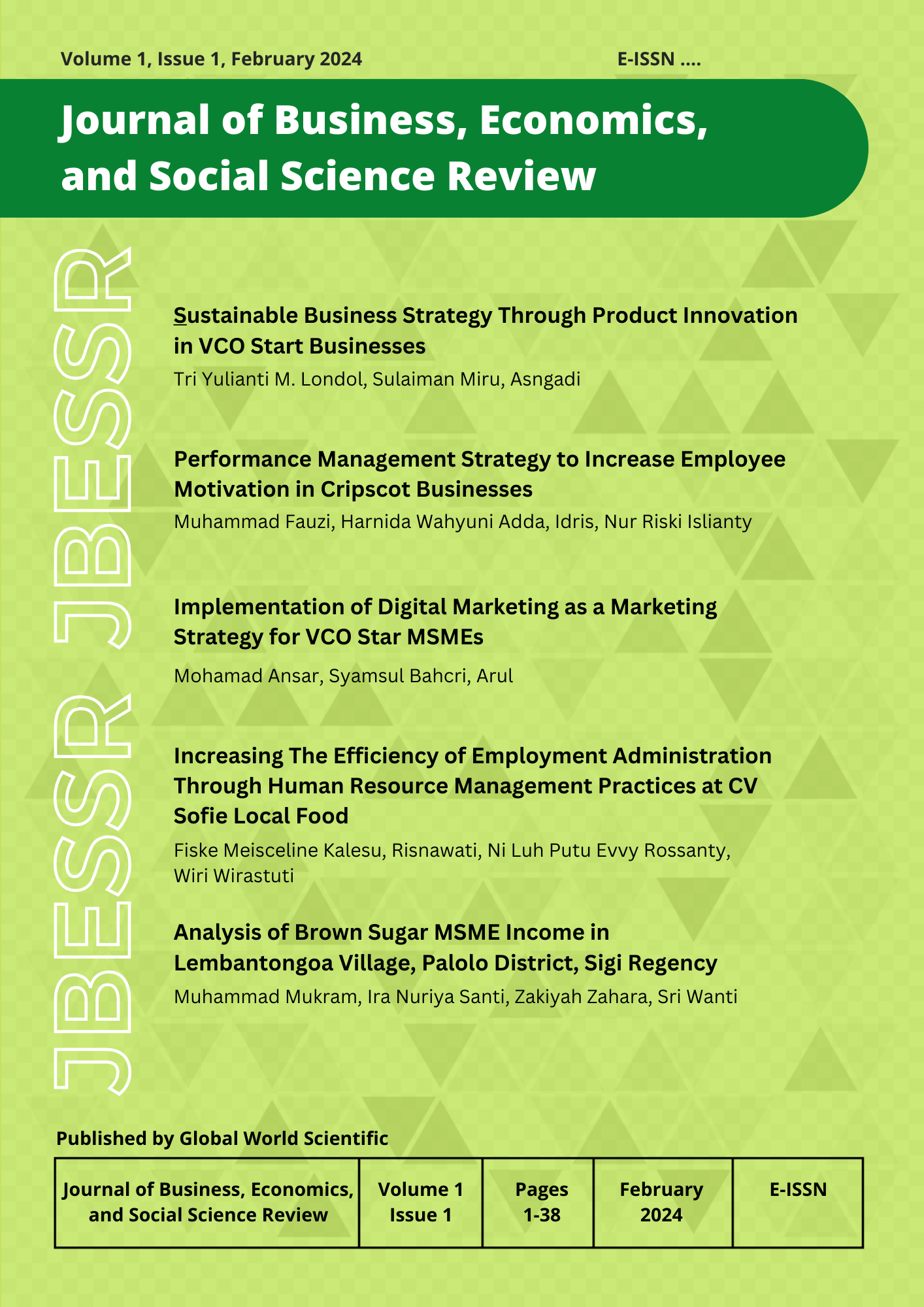
Performance Management Strategy to Increase Employee Motivation in Cripscot Businesses
DOI:
https://doi.org/10.58857/JBESSR.2024.v01.i01.p02Keywords:
performance management, motivation, leadership, human reseurcesAbstract
This research aims to analyze performance management strategies that can increase employee motivation in the Cripscot business. This research uses a qualitative approach by combining literature study, participant observation, and semi-structured interviews. The variables studied involve leadership, supervisory supervision, and employee work motivation. The findings of this study highlight the vital role of clear goal setting, regular feedback, fair performance appraisals, and recognition of achievements in creating a work environment that supports motivation. This strategy not only improves productivity but is also key to retaining and attracting the best talent. Additionally, the integration of technology, such as digital platforms and data analytics, can enrich performance management, creating greater responsiveness and effectiveness. These conclusions provide practical direction for organizational leaders to design relevant and adaptive approaches.
Downloads
References
Adda, H. W., Natsir, S., Hasanuddin, B., Rossanty, N. P. E., Cornelius, Y., & Ardianto, H. (2022). A Concept of Human Resource Development in Copra Agroindustrial Management System. Proceedings of the 2021 Tadulako’s International Conference on Social Sciences, 674, 115–119. https://doi.org/10.2991/assehr.k.220707.026
Afriyie, S., Du, J., & Ibn Musah, A. A. (2020). The nexus among innovation types, knowledge sharing, transformational leadership, and marketing performance in an emerging economy: An empirical study. Journal of Indian Business Research, 12(4), 529–548. https://doi.org/10.1108/JIBR-03-2019-0082
Anwari, F., Siswanta, & Riyanto, B. (2016). Hubungan Word Of Mouth Terhadap Keputusan Pelanggan Di Percetakan Amani Offset Surakarta. Jurnal Transformasi, 1(1), 57–61. https://doi.org/10.4234/jjoffamilysociology.28.250
Kotler, P., & Amstrong, G. (2014). Principles of Marketing, 12th Edition, Jilid 1 Terjemahan Bob Sabran. Jakarta : Erlangga.
Lena Ellitan. (2002). Praktik-Praktik Pengelolaan Sumber Daya Manusia Dan Keunggulan Kompetitif Berkelanjutan. Jurnal Manajemen Dan Kewirausahaan, 4(2), pp.65-76. http://puslit2.petra.ac.id/ejournal/index.php/man/article/view/15623
Mas’ud, L. P., & Susilo, M. Y. (2023). Peran UMKM Dalam Membangun Dan Menumbuhkan Ekonomi Kreatif Di Era Revolusi 5.0 Menuju Ekonomi Global. Jurnal Ilmiah Metansi, 6(2), 266–275.
Mihreza, A.-A. H. E., & Armanu. (2014). The Importance of Leadership Behavior and Motivation In Creating Employee Performance: (A Study at the Faculty of Economics and Business, University of Brawijaya). Asia-Pacific Management and Business Application, 3(2), 86–105. http://apmba.ub.ac.id
Muda, S., Rahman, M. R. C. A., Hamzah, N., & Saleh, N. M. (2020). Intellectual Capital and SMEs’ Business Performance from an Organisational Lifecycle Perspective. The South East Asian Journal of Management, 14(1). https://doi.org/10.21002/seam.v14i1.11939
Neuman, W. L. (2014). Social Research Methods: Qualitative and Quantitative Approaches, 7th edition. Pearson Education, Inc.
Nurmansyah, A., Taufik, Y., Ayuningtyas, F., & Melinda, L. D. (2023). Analisis Kerja Pegawai di Kantor Pelayanan Perbendaharaan Negara (KPPN) Bandung II. Jurnal Administrasi Bisnis, 9(1), 141–148.
Parinsi, W. K., & Musa, D. A. L. (2023). Strategi Pengelolaan Sumber Daya Manusia Untuk Meningkatkan Kinerja Perusahaan yang Berkelanjutan di Industri 4.0. Jurnal Manajemen Dan Sains, 8(2), 1385. https://doi.org/10.33087/jmas.v8i2.1510
Rahman, G. M., & Shanjabin, S. (2022). The trilogy of job stress, motivation, and satisfaction of police officers: Empirical findings from Bangladesh. International Journal of Financial, Accounting, and Management, 4(1), 85–99. https://doi.org/10.35912/ijfam.v4i1.866
Riel, C. B. M. Van, Berens, G., & Dijkstra, M. (2009). Stimulating strategically aligned behaviour among employees. Journal of Management Studies, 46(7), 1197–1226. https://doi.org/10.1111/j.1467-6486.2009.00837.x
Riyanto, A., Eriyatno, P. B., & Maulana, A. (2014). Perancangan model integrasi manajemen kebijakan outsourcing dalam perspektif hubungan industrial. Jurnal Manajemen Teknologi, 79–74. https://doi.org/doi: 10.12695/ jmt.2014.13.1.7
Robbins, D. L., & Galperin, B. L. (2010). Constructive deviance: striving toward organizational change in healthcare. In Journal of Management & Marketing Research (Vol. 5, pp. 1–11). Citeseer. http://search.ebscohost.com/login.aspx?direct=true&db=bth&AN=55041691&site=bsi-live
Suyanto. (2012). The Effect of Human Resources on Capital of Worker Cooperative. The South East Asian Journal of Management, 6(1). https://doi.org/10.21002/seam.v6i1.1046
Witasari, J., & Gustomo, A. (2020). Understanding The Effect of Human Capital Management Practices, Psychological Capital, and Employee Engagement To Employee Performances. The Asian Journal of Technology Management, 13(1), 1–15. https://doi.org/10.12695/ajtm.2020.13.1.1
Wulandari, A., Tania, K. D., Wedhasmara, A., & Meiriza, A. (2023). The effect of transformational leadership on innovative work behavior: mediating role of knowledge sharing. Management and Business Review, 7(2), 169–183. https://doi.org/10.1108/PR-04-2018-0133
Yuniarsih, T., & Suwatno. (2011). Manajemen Sumber Daya Manusia: Teori, Aplikasi dan Isu Penelitian. Bandung: Alfabeta.
Downloads
Published
How to Cite
Issue
Section
License
Copyright (c) 2024 Journal of Business, Economics, and Social Science Review

This work is licensed under a Creative Commons Attribution-NonCommercial-ShareAlike 4.0 International License.